
Dictionary of Architectural Terms
Exterior design is defined by proportion, hierarchy, and material relationships.
The terms below describe structural and architectural elements that directly influence facade balance and visual coherence.
This reference supports informed, intentional design decisions.
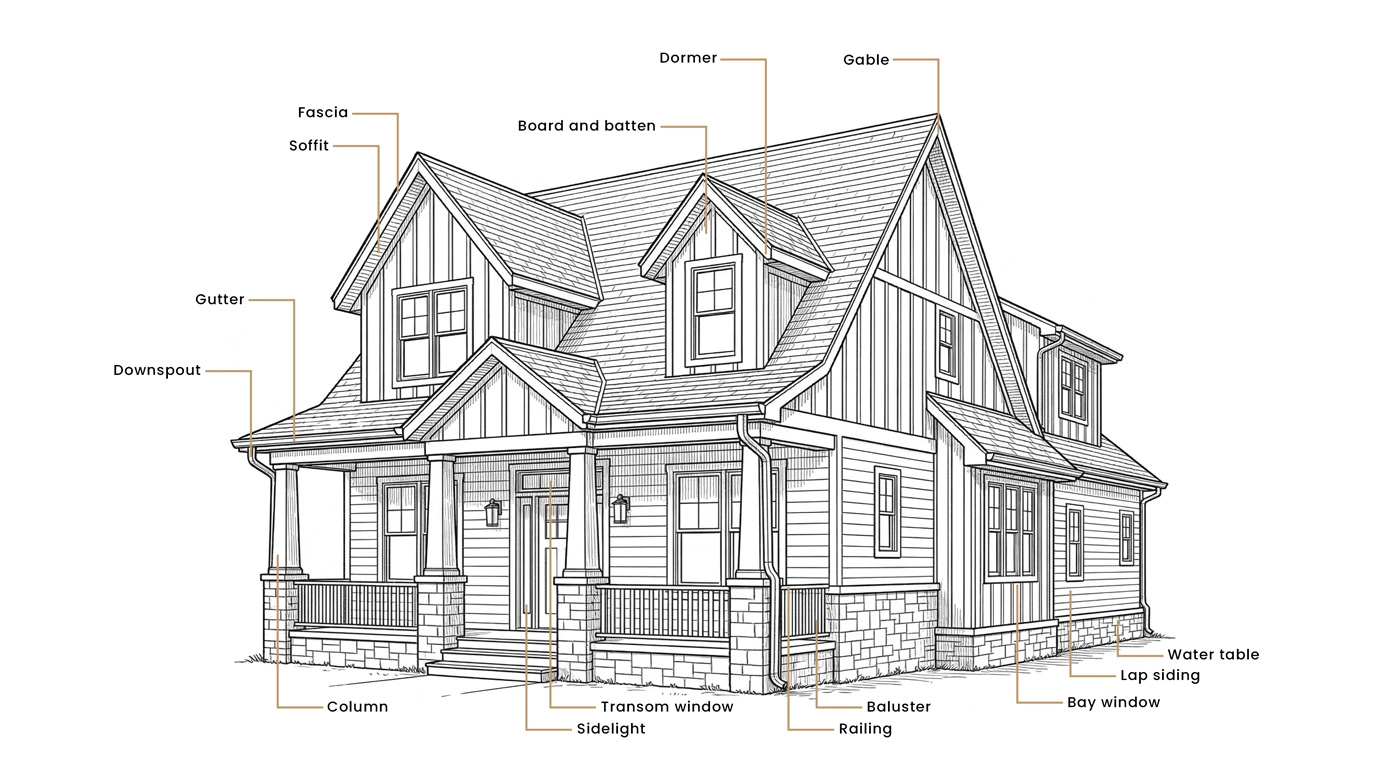
This dictionary represents the architectural language we work with daily.
It focuses on the elements that shape structure, material transitions, and facade balance — the components that determine whether a design feels resolved or unresolved.
Terms are organized by area of the home to reflect how we analyze and refine each project.
You may encounter this terminology referenced directly within your design documentation.
Exterior Siding
Exterior siding refers to the outermost material layer applied to a home’s wall assembly. It serves both protective and architectural functions, shielding the structure from weather exposure while defining the primary visual language of the facade.
The orientation, scale, and transitions between siding materials directly influence proportion, shadow, and perceived mass. As the dominant exterior surface, siding plays a critical role in establishing coherence, hierarchy, and overall architectural character.
- Board and Batten
A vertical siding system composed of wide boards with narrow battens covering the joints.
Architectural Impact: Emphasizes verticality and can visually elongate the facade. When proportioned correctly, it introduces strong rhythm and clean shadow definition.
Commonly Associated Styles:
Modern Farmhouse, Contemporary, Scandinavian, Cottage, Transitional.
- Lap Siding
Horizontal cladding installed in overlapping courses, traditionally wood but also available in fiber cement and composite materials.
Architectural Impact:
Reinforces horizontal lines and establishes consistent shadow bands across the elevation. Exposure dimension directly influences perceived scale.
Commonly Associated Styles:
Colonial, Craftsman, Cape Cod, Traditional American, Coastal.
- Shake Siding
Small-format wood or composite shingles applied in staggered courses, typically used as an accent within gables or upper wall sections.
Architectural Impact:
Introduces texture and visual differentiation. Often used to break up large wall planes and soften rigid geometry.
Commonly Associated Styles:
Craftsman, Shingle Style, Cottage, Coastal, Cape Cod.
- Clapboard
A traditional form of horizontal wood siding consisting of long, narrow boards with a slight taper.
Architectural Impact:
Creates refined horizontal rhythm and subtle shadow transitions. Typically contributes to a more historically grounded facade expression.
Commonly Associated Styles:
Colonial, Georgian, Federal, New England Traditional.
- Masonry
Exterior wall construction using brick, stone, or concrete units laid in defined courses or patterns.
Architectural Impact:
Adds visual weight and permanence. Frequently anchors the base of the home and establishes material contrast with lighter upper cladding.
Commonly Associated Styles:
Colonial, Tudor, Traditional, European-inspired, Transitional.
- Stone Veneer
A non-structural stone facing applied over a framed wall assembly to replicate full masonry appearance.
Architectural Impact:
Provides texture and mass without structural load-bearing function. Often used strategically to ground elevations or highlight architectural features.
Commonly Associated Styles:
Modern Farmhouse, Craftsman, Rustic, Transitional, European Country.
- Water Table
A horizontal trim or material transition separating the lower and upper portions of a facade.
Architectural Impact:
Creates a defined visual break and reinforces base-to-body proportion. Often strengthens facade grounding and clarifies material hierarchy.
- Corner Trim
Vertical trim boards installed at exterior corners to conceal cladding transitions and define facade edges.
Architectural Impact:
Frames the elevation and reinforces architectural clarity. Scale and thickness influence perceived formality.
- Frieze Board
A horizontal trim board located at the top of the wall beneath the soffit or roofline.
Architectural Impact:
Provides a clean termination between wall and roof elements. Helps establish proportional transition at the roofline.
- Stucco
A cement-based exterior finish applied as a continuous plaster coating over masonry or framed wall systems.
Architectural Impact:
Creates smooth, monolithic wall surfaces with minimal joint articulation. Contributes to a more sculpted, unified facade appearance.
Commonly Associated Styles:
Mediterranean, Spanish Revival, Modern, Contemporary, Southwestern.
Exterior Finishes
Exterior finishes define how architectural materials are ultimately perceived. Beyond structural cladding, finish treatments influence color hierarchy, light behavior, contrast, and material continuity across the facade.
While siding establishes form, finishes refine proportion and visual balance through tone, texture, and surface treatment.
- Paint
A protective pigmented coating applied to exterior surfaces including siding, trim, masonry, and architectural details.
Architectural Impact:
Paint establishes primary color relationships and controls overall facade cohesion. Strategic application can visually adjust scale, emphasize structure, or reduce visual fragmentation.
- LRV (Light Reflectance Value)
A numerical measurement indicating the percentage of visible light a color reflects.
Architectural Impact:
LRV influences perceived brightness and contrast. Larger LRV differences between adjacent elements create stronger definition; minimal differences produce subtle transitions and unified compositions.
- Limewash
A mineral-based coating typically applied to masonry surfaces, producing a matte, breathable finish that gradually patinas over time.
Architectural Impact:
Softens tonal variation in brick or stone while maintaining surface texture. Introduces depth without fully obscuring underlying material character.
Associated Styles:
European Country, Traditional, Mediterranean, Rustic.
- German Smear
A mortar-based application partially spread over brick to create a textured, aged surface treatment.
Architectural Impact:
Reduces brick color contrast while preserving dimensional relief. Adds irregularity and visual movement to otherwise uniform masonry.
Associated Styles:
European Cottage, Tudor, Old World-inspired, Rustic.
- Color Blocking
The intentional use of contrasting or complementary colors to differentiate architectural volumes or facade sections.
Architectural Impact:
Clarifies massing and establishes hierarchy. Controlled color separation can visually reduce scale or highlight focal elements.
Associated Styles:
Contemporary, Modern Farmhouse, Transitional.
- Trim Contrast
The visual distinction between primary wall surfaces and trim elements such as windows, fascia, and corner boards.
Architectural Impact:
High contrast sharpens architectural lines and emphasizes detailing. Low contrast produces a quieter, more unified facade expression.
- Material Transition
The junction between two exterior materials or finishes.
Architectural Impact:
Transitions define structural hierarchy and proportion. Well scaled transitions reinforce composition; poorly executed transitions disrupt facade continuity.
- Accent Panel
A defined facade section treated with a contrasting material or color to create emphasis.
Architectural Impact:
Directs visual focus and introduces controlled variation. When proportioned correctly, accent panels strengthen hierarchy; overuse fragments composition.
Associated Styles:
Contemporary, Modern, Transitional.
Windows & Doors
Windows and doors define the geometry and distribution of openings within the facade. Their size, placement, and alignment regulate structural rhythm and establish proportional relationships across the elevation.
Beyond function, framing depth, articulation, and subdivision influence visual weight and compositional hierarchy. As transitional elements between interior and exterior, they play a critical role in balancing light, mass, and architectural clarity.
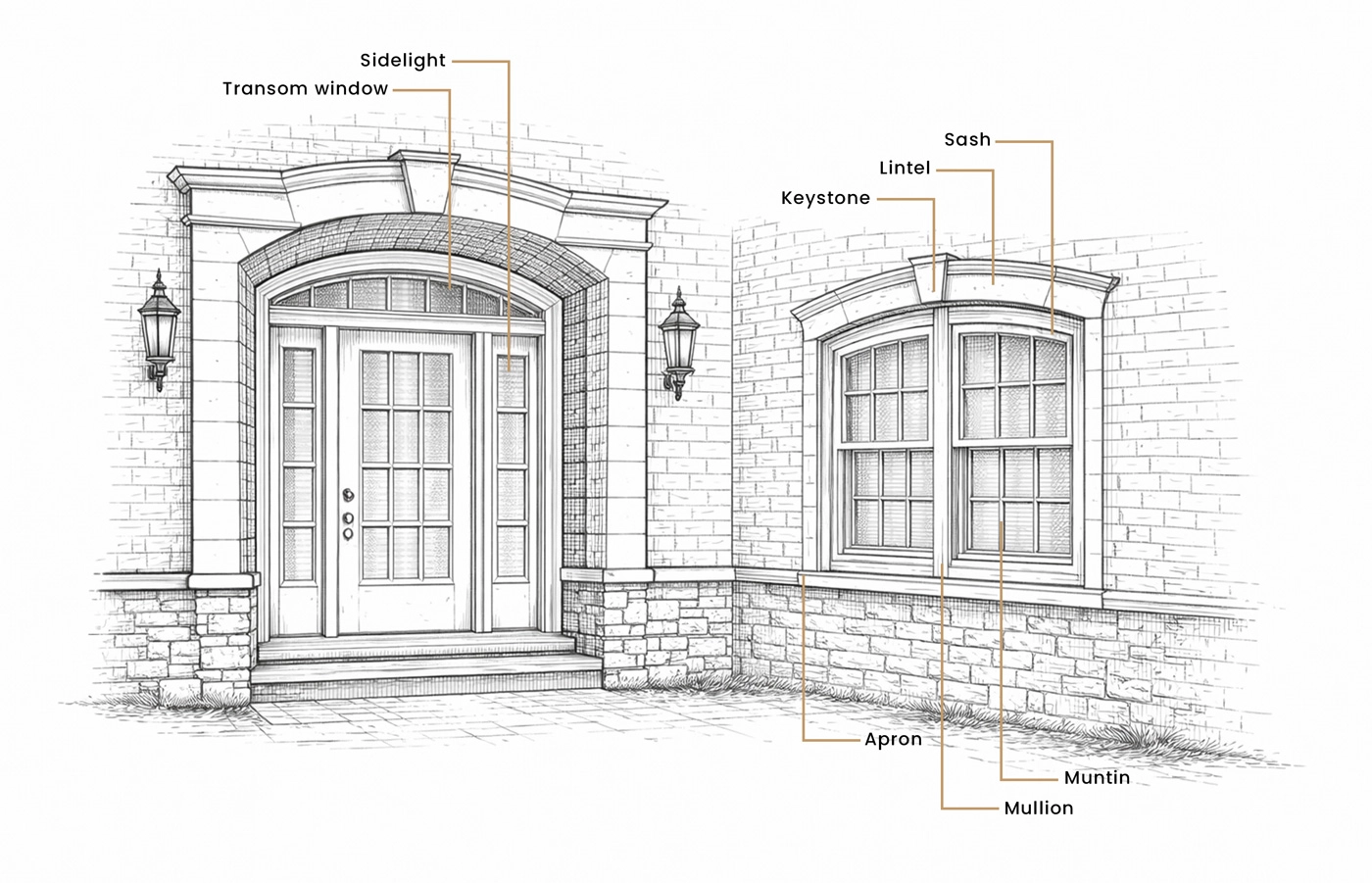
- Muntin
A secondary glazing bar within a sash that subdivides a window into smaller lites.
Architectural Impact:
Controls pane geometry and formal expression through grid configuration and scale.
- Mullion
A central, wedge-shaped element positioned at the apex of an arch or above an opening within classical compositions.
Architectural Impact:
Introduces axial emphasis and formal articulation.
- Keystone
A central, wedge-shaped element positioned at the apex of an arch or above an opening within classical compositions.
Architectural Impact:
Introduces axial emphasis and formal articulation.
- Lintel
A load-bearing horizontal structural element spanning above an opening.
Architectural Impact:
Visually expresses structural support and contributes to material weight and hierarchy.
- Header
A horizontal framing member located above a window or door within a wall assembly; in exterior applications, often expressed through trim or dimensional projection.
Architectural Impact:
Establishes visual termination at the top of the opening and strengthens proportional hierarchy.
- Sill
The horizontal base component of a window opening, typically sloped for water shedding.
Architectural Impact:
Defines lower boundary conditions and creates a shadow break at the facade plane.
- Sash
The framed component of a window assembly that holds the glazing and, in operable units, facilitates movement.
Architectural Impact:
Sash thickness and proportion influence visual weight and opening clarity.
- Jamb
The vertical side framing of a window or door opening forming part of the structural enclosure.
Architectural Impact:
Jamb depth communicates wall thickness and affects perceived facade mass.
- Egress Window
A code-compliant window meeting minimum dimensional requirements for emergency escape and rescue.
Architectural Impact:
May alter proportional balance at lower elevations due to size constraints.
- Window Frame
The outer structural perimeter enclosing the window assembly and securing it within the wall opening.
Architectural Impact:
Frame dimension contributes to facade depth and edge definition.
- Window Trim
Applied casing or surround detailing that frames a window opening.
Architectural Impact:
Clarifies edge conditions and reinforces stylistic direction.
- Apron
A horizontal trim element installed directly below a window sill.
Architectural Impact:
Adds layered articulation and enhances traditional detailing systems.
- Transom
A secondary horizontal window positioned above a primary window or door opening.
Architectural Impact:
Extends vertical proportion while maintaining primary opening width.
- Sidelights
Narrow vertical glazed units positioned adjacent to a door.
Architectural Impact:
Increase entry scale and reinforce vertical alignment.
Roof Structure
The roof defines the upper structural enclosure of the building and establishes its primary volumetric expression. Its geometry, pitch, and plane intersections shape overall massing relationships and influence facade hierarchy.
Edge articulation, overhang proportion, and termination details regulate shadow behavior and structural legibility. As a defining element of silhouette, the roof plays a critical role in architectural identity and compositional balance.
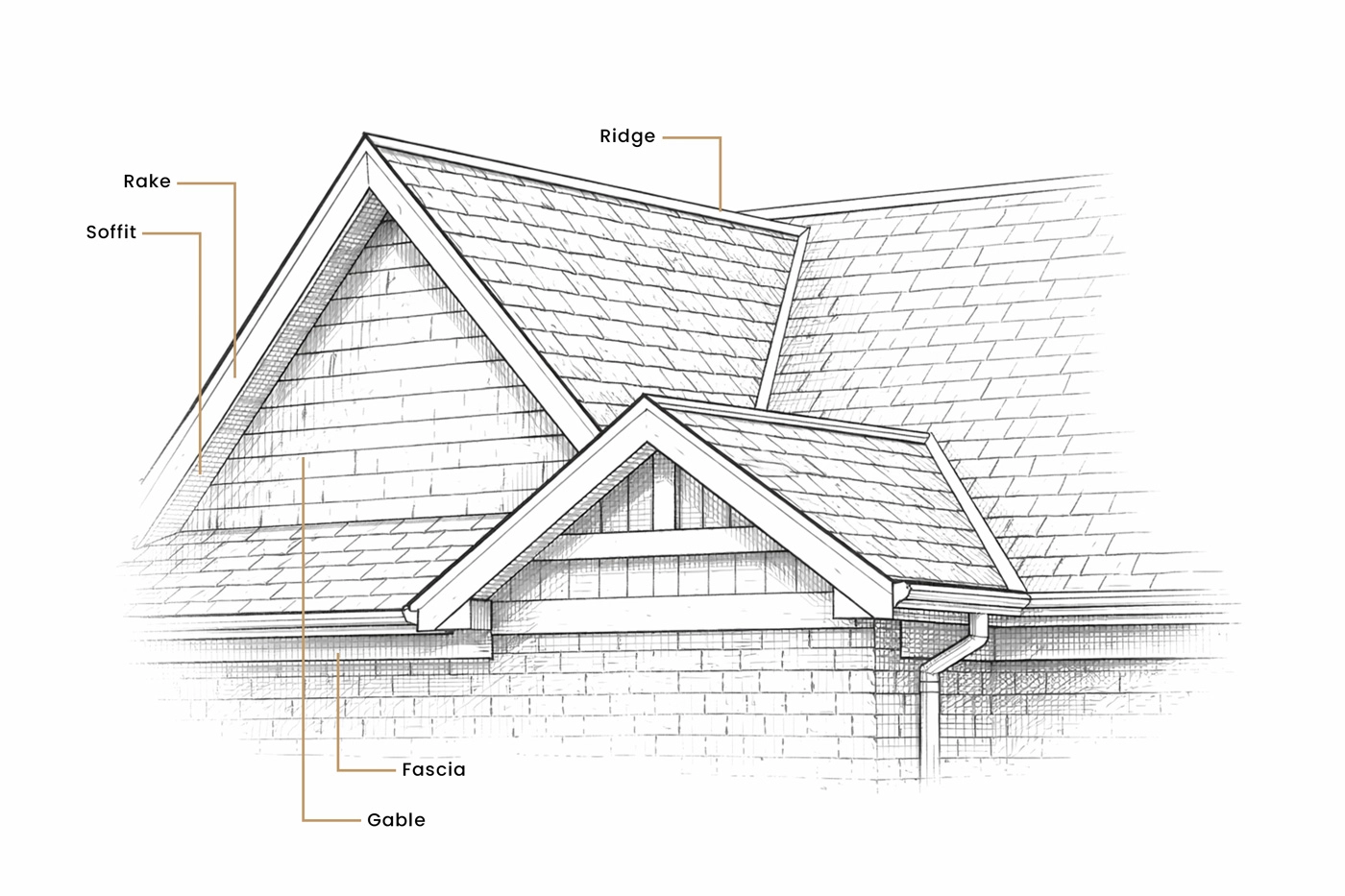
- Gable
A gable is a triangular vertical wall section formed where two sloping roof planes meet at a ridge. It creates a defined end condition within pitched roof assemblies.
Architectural Impact: Gables introduce vertical emphasis and directional clarity to the building form. Their scale and placement directly influence facade hierarchy and roof silhouette.
- Ridge
The ridge is the highest horizontal intersection line between two opposing roof planes. It forms the primary structural and geometric axis of a pitched roof.
Architectural Impact: The ridge establishes the central organizing line of the roof composition. Its length and alignment reinforce symmetry or directional emphasis within the massing.
- Hip
A hip is an external inclined intersection formed where two sloped roof planes meet. Unlike a gable, it does not produce a vertical triangular wall surface.
Architectural Impact: Hip conditions create a more consolidated and continuous roof mass. They soften volumetric transitions and often produce a more restrained silhouette.
- Rake
The rake is the inclined edge of a gable roof extending from the ridge down to the eave. It defines the exposed termination of the roof plane at the gable end.
Architectural Impact: Rake detailing frames the gable surface and influences perceived roof thickness. Trim dimension and projection affect edge clarity and formal expression.
- Fascia
Fascia is a horizontal finishing board attached to the ends of roof rafters along the eave. It provides a mounting surface for gutters and completes the roof edge assembly.
Architectural Impact: Fascia depth visually defines roof thickness. Its proportion establishes a clear horizontal boundary between roof plane and wall assembly.
- Eave
The eave is the lower edge of a roof that projects beyond the exterior wall plane. It forms the primary overhang condition of the building.
Architectural Impact: Eave depth regulates shadow projection and solar protection. Overhang proportion significantly affects perceived facade depth and balance.
- Soffit
The soffit is the finished underside surface of the roof overhang. It encloses structural framing at the eave.
Architectural Impact: Soffit treatment reinforces horizontal continuity along the roof edge. Material and vent detailing influence perceived refinement and roof articulation.
- Vent
A vent is an opening integrated into the roof or gable assembly to regulate attic airflow and manage thermal buildup within the roof structure. Proper ventilation supports long-term roof performance by reducing moisture accumulation and temperature imbalance within the envelope.
Types: gable, roof and ridge vent. Although primarily functional, vent type and placement influence roof plane continuity and compositional rhythm. When proportioned and aligned carefully, ventilation elements remain visually subordinate while preserving geometric clarity of the roof form.
Gutter System
The gutter system manages rainwater runoff from the roof and directs it safely away from the building envelope. By controlling water flow along roof edges and exterior walls, it helps prevent moisture intrusion, foundation damage, and premature deterioration of exterior materials.
Properly designed gutter systems work in coordination with roof drainage elements and site grading. Beyond their functional role, their placement and detailing contribute to the visual clarity of the roofline and the overall composition of the exterior.
- Gutter
A gutter is a horizontal channel installed along the edge of the roof that collects rainwater and directs it toward the downspouts.
Architectural Impact: Gutters visually define the roof edge and fascia line. Their profile, size, and mounting method influence the perceived crispness of the roof termination and the continuity of the roofline.
- Downspout
A downspout is a vertical pipe connected to the gutter system that carries collected rainwater from the roof down to the ground drainage system.
Architectural Impact: Downspouts create vertical lines along the facade. Their placement and alignment with architectural elements help maintain visual order and minimize disruption of façade composition.
- End Cap
End caps are fittings installed at the ends of gutters to seal the system and prevent water from spilling out.
Architectural Impact: Although small in scale, end caps complete the visual termination of the gutter system. Clean detailing contributes to a refined and finished roof edge appearance.
- Rain Chain
A rain chain is a decorative alternative to a traditional downspout that guides rainwater from the gutter to the ground through a series of linked cups or chains.
Architectural Impact: Rain chains introduce a vertical decorative element to the drainage system. When used intentionally, they soften the appearance of the facade while maintaining effective water management and adding visual interest near roof edges and entry areas.
Site & Exterior Elements
Site and exterior elements define how a building interacts with its surrounding landscape and outdoor living spaces. These architectural and landscape features shape circulation, create functional outdoor areas, and influence the visual composition of the property.
When thoughtfully designed, exterior elements extend the architectural language of the home into the site, reinforcing spatial hierarchy, outdoor usability, and the overall identity of the residence.
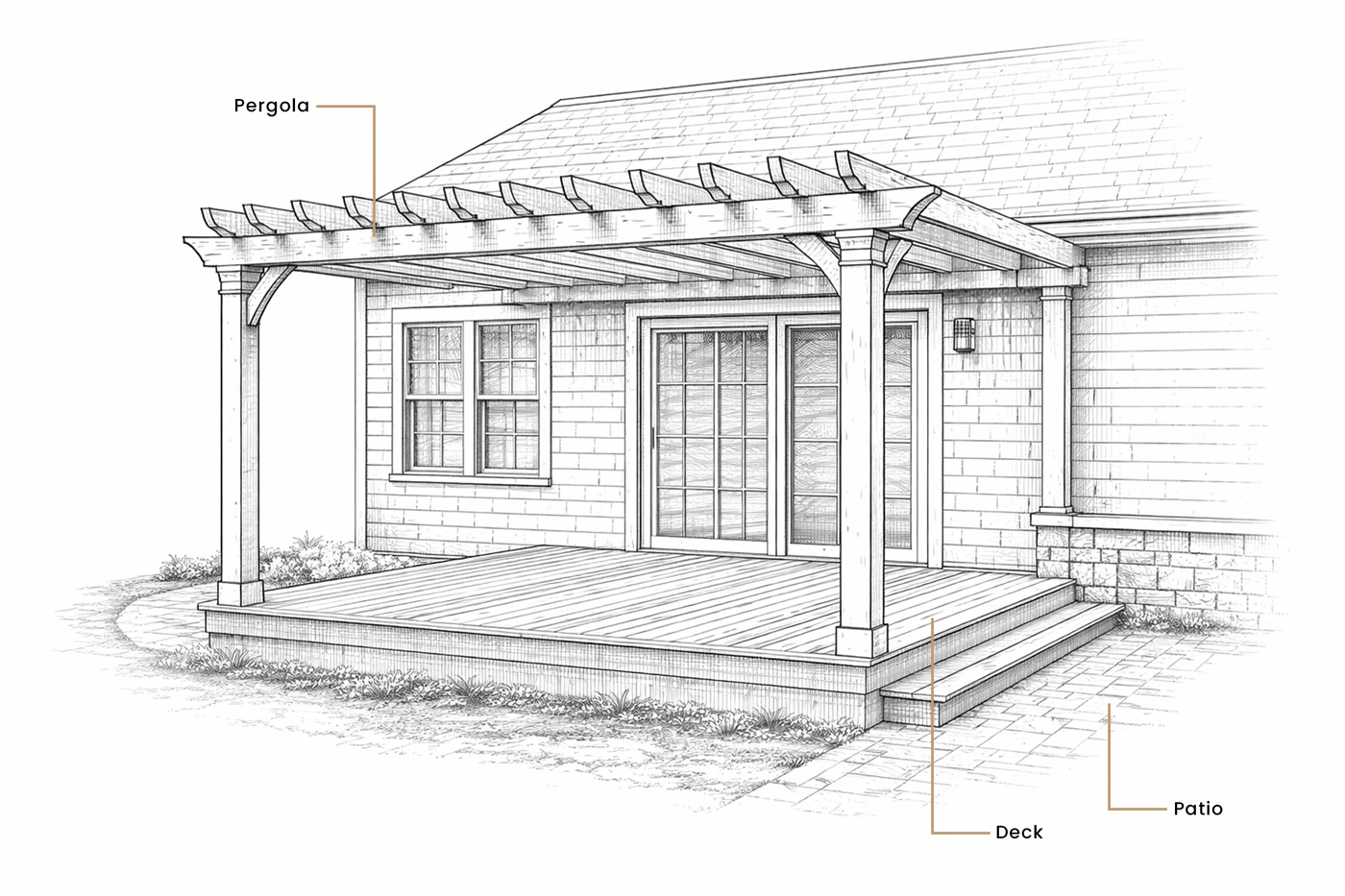
- Pergola
A pergola is an outdoor structure consisting of vertical posts supporting an open lattice or beam roof.
Architectural Impact: Pergolas create partial shade while defining outdoor gathering spaces. Their rhythm of posts and beams introduces architectural structure and visual depth to patios and gardens.
- Deck
A deck is an elevated outdoor platform typically constructed of wood or composite materials and attached to the building.
Architectural Impact: Decks extend living spaces into the outdoors. Their height, railing design, and connection to the house influence the visual transition between architecture and landscape.
- Porch
A porch is a covered exterior platform attached to the entrance of a building, often supported by columns and integrated into the main structure.
Architectural Impact: Porches create a transitional space between the interior and exterior. They contribute to the building’s scale, rhythm, and social character while emphasizing the main entry.
- Portico
A portico is a small roofed structure supported by columns that shelters an entrance.
Architectural Impact: Porticos provide architectural emphasis to entry points. Their classical proportions and column detailing reinforce symmetry and formal hierarchy within the facade composition.


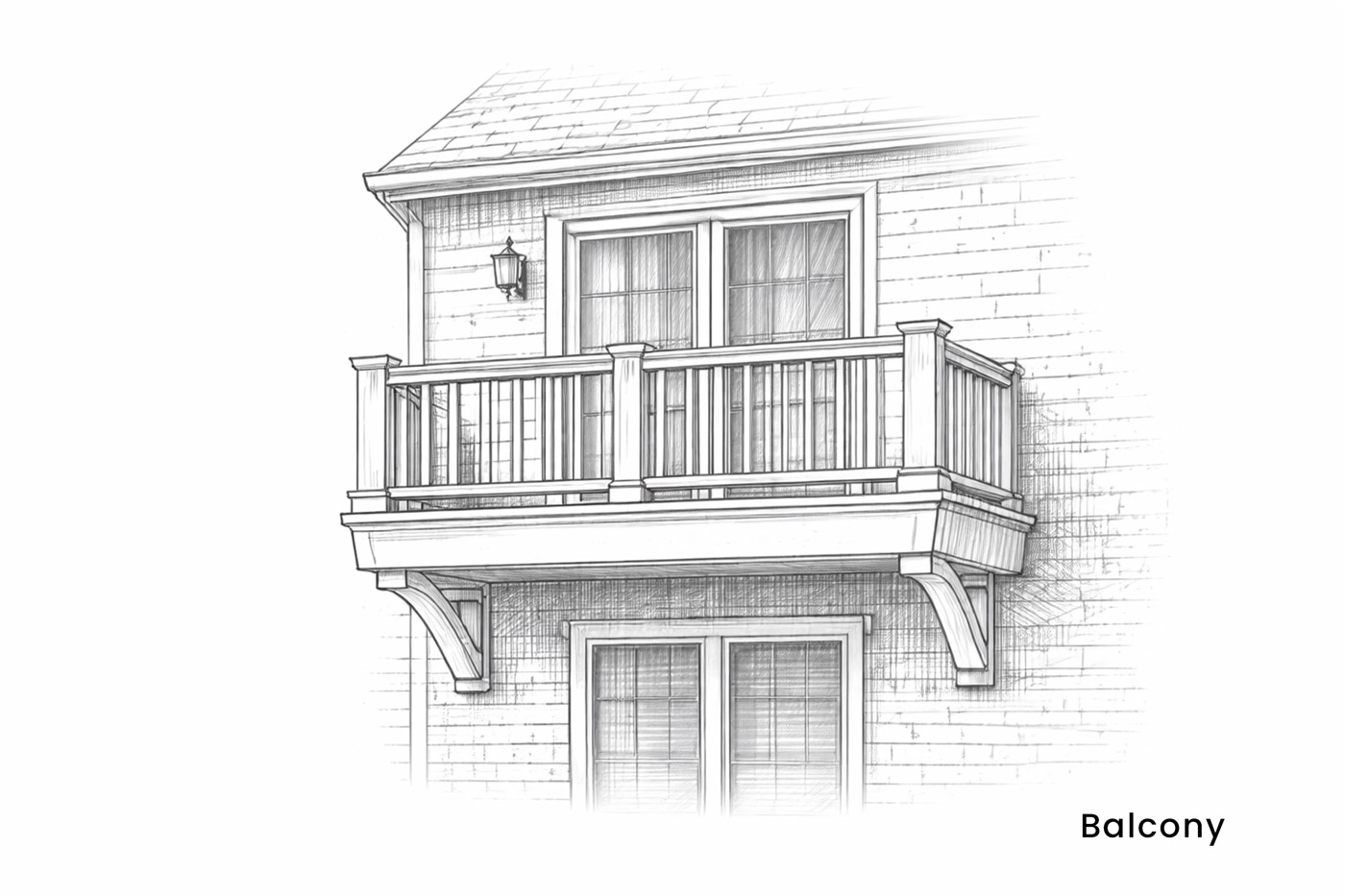
- Balcony
A balcony is a projecting platform attached to the exterior wall of an upper floor, enclosed by a railing or balustrade.
Architectural Impact: Balconies add vertical articulation and depth to the façade. Their scale and placement influence the building’s rhythm and spatial relationship with the surrounding landscape.
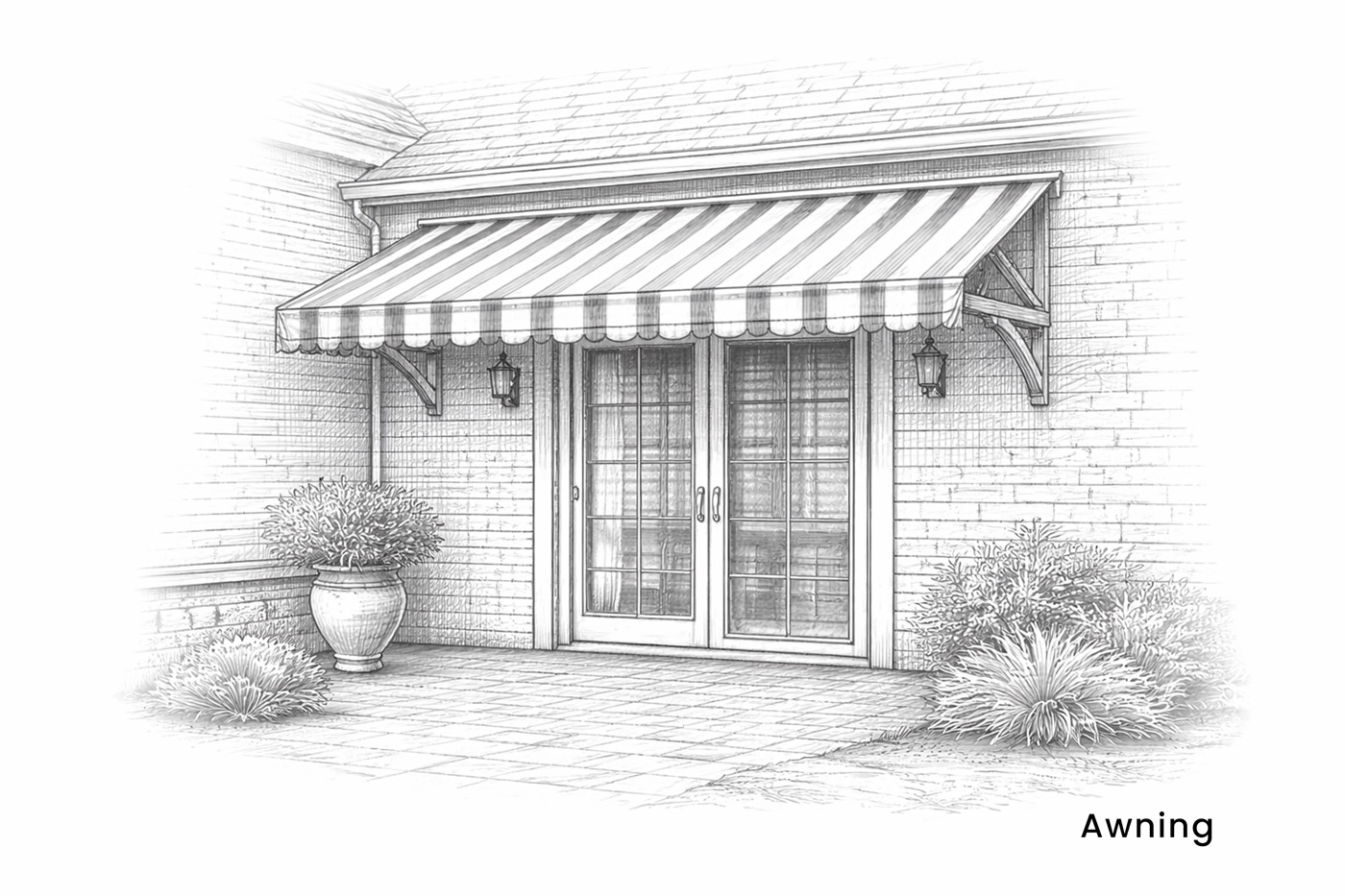
- Awning
An awning is a secondary covering attached to the exterior wall above windows, doors, or outdoor spaces to provide shade and weather protection.
Architectural Impact: Awnings add horizontal emphasis to facades while improving comfort at entrances and windows. Their form and material can reinforce or soften the architectural style of the building.
- Patio
A patio is a ground-level outdoor space, usually paved with stone, concrete, or brick, designed for seating and outdoor activities.
Architectural Impact: Patios establish primary outdoor living zones. Their geometry and material selection help anchor the building within the site composition.
- Courtyard
A courtyard is an enclosed or partially enclosed outdoor space surrounded by walls or building structures.
Architectural Impact: Courtyards create protected outdoor rooms that enhance privacy and spatial hierarchy. They strengthen the relationship between architecture and landscape.
- Railing
A railing is a protective barrier installed along edges of decks, balconies, stairs, and porches.
Architectural Impact: Railings contribute to both safety and visual rhythm. Their material, spacing, and detailing influence the perceived lightness or solidity of exterior structures.
- Columns
Columns are vertical structural or decorative elements that support roofs, porches, or porticos.
Architectural Impact: Columns establish vertical order and proportion within the façade. Their form, spacing, and detailing reinforce the architectural style and structural clarity of the building.
- Hardscope
Hardscape refers to the non-living structural elements used in landscape and site design, such as paving, stonework, walls, and built outdoor features.
Architectural Impact: Hardscape establishes spatial organization and circulation throughout the site. Material selection, pattern, and layout influence the perceived structure, hierarchy, and cohesion of the exterior environment.
- Retaining Wall
A retaining wall is a structural wall designed to hold back soil and stabilize sloped terrain.
Architectural Impact: Retaining walls shape the topography of a site and create usable outdoor terraces. Their materiality and alignment contribute to the visual structure and layering of the landscape.
Understanding Exterior Architecture
The terms presented in this dictionary help explain the many elements that shape a home’s exterior. From roof structures and facade details to site features and outdoor spaces, each component plays a role in defining the character, performance, and visual balance of a building.
You don’t need to remember every term. However, having a basic understanding of this vocabulary can make it easier to discuss ideas, evaluate design possibilities, and communicate clearly throughout the design process.
This guide is intended as a practical reference to help you better understand the architectural language behind exterior design. When these elements are thoughtfully combined, they create a cohesive and well-balanced exterior composition.
Every exterior is a composition of elements working together in balance.